
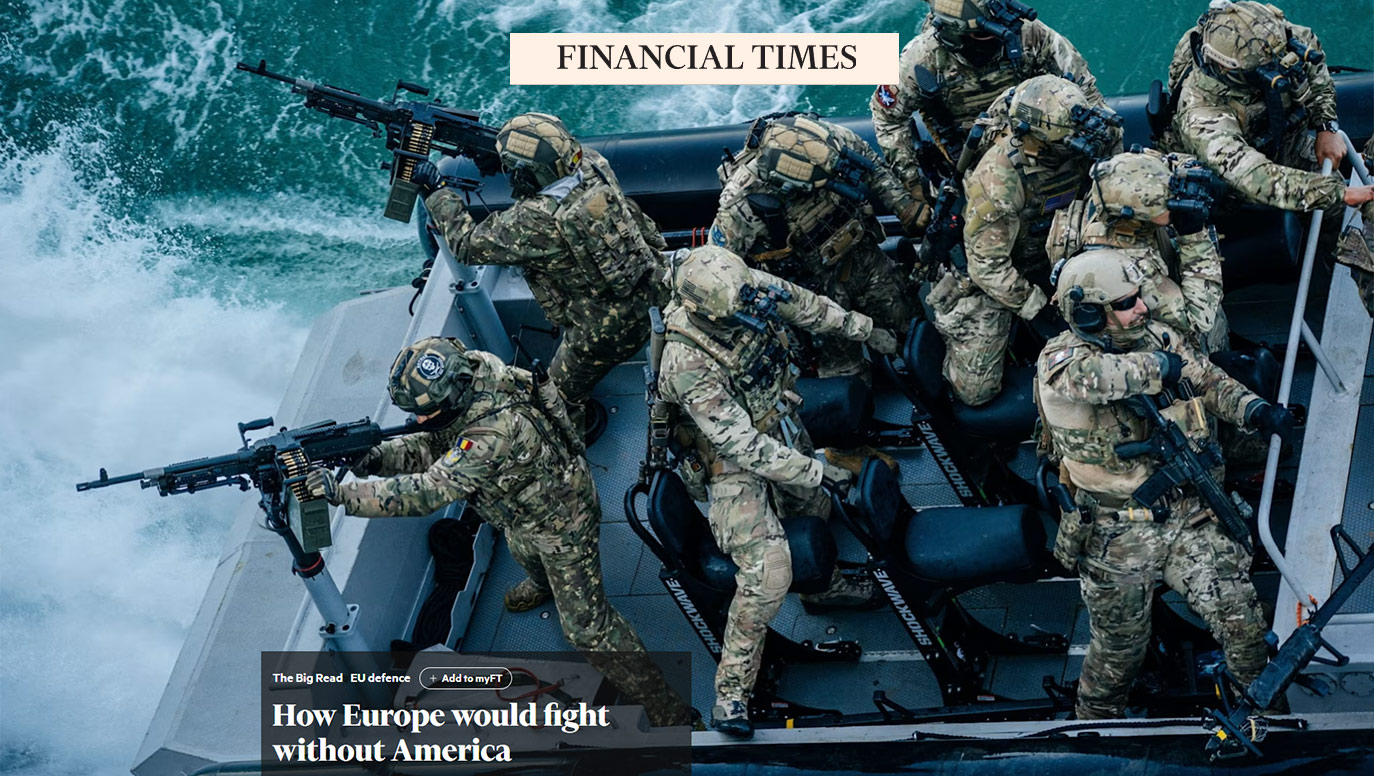
Photo:© Andrei Pungovschi/Getty Images
by Ben Hall and Charles Clover in London and Henry Foy in Ankara
Published July 6 2026
Behind the expected show of unity at this week’s Nato summit, Europe’s military powers are beginning to think the unthinkable.
Tuesday’s gathering in Ankara comes after 12 months in which European governments have lost trust in US President Donald Trump’s willingness to come to his allies’ aid. That in turn has prompted questions that would be inconceivable only a year ago.
How would Europe defend itself without America? How would it fight without the US military leadership and overwhelming firepower that has underpinned Nato doctrine for generations?
Europe is still grappling with the financial and military implications of taking on more of the burden within the alliance — let alone doing so without the US altogether. But given Trump’s recriminations over defence spending and lack of European support for his war in Iran, the continent’s leaders can no longer ignore the scenario in which they have to fend off Russian aggression with much less American support — and possibly none at all.
“We really are not in good shape,” says a senior French official. “Trump now has his talking point [Iran]. Whatever we do, he’ll say, ‘Nato wasn’t there for us’.”
An unreliable and possibly adversarial America is forcing a radical reassessment in European capitals about how to organise their own security, according to interviews with more than a dozen diplomats, defence officials and military officers.
The discussions encompass everything from political leadership and command structures to warfighting doctrine and procurement.
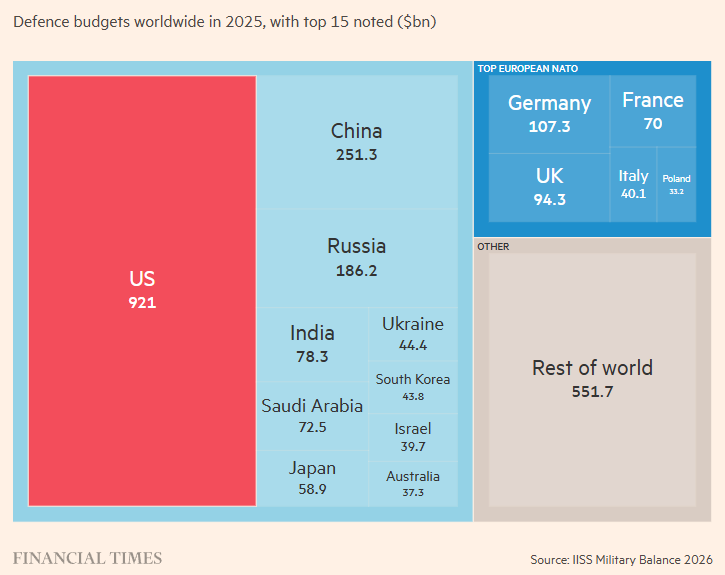
They anticipate less American involvement but also more from Ukraine. They also assume that Europeans, together with their Canadian allies, will end up doing things differently whether by choice or necessity.
Moreover, a massive advantage in conventional military terms is no longer necessarily the guarantee of success it was in the past. Ukraine’s fightback against Russia has shown as much, as have the difficulties Iran has posed to the US.
Some officials and experts say the continent will have to devise a new European way of war that features more regional leadership, lower-cost weapons, more efficient production and new strategies for protecting against Russian aggression.
“We are seriously thinking about what we as Europe want our future defence posture to look like,” says the French official. “Less America is not just about fewer [US] troops or tanks coming to support us: it’s about questioning how we will fight if we don’t need to fight like Americans.”
For many Europeans, facing an aggressive Russia without, or with less, American help is an alarming prospect.
With the Trump administration wanting a faster withdrawal of American troops from Europe than the US military, and possibly an abrupt one, this is “an unusually dangerous moment” that Moscow might exploit to test European security, says a senior UK official. “We have to be ready for that.”
There is still nervousness in some European capitals about openly preparing for a reduced US role in the continent’s defence, lest it become a self-fulfilling prophecy.
But Alexandra de Hoop Scheffer, president of the German Marshall Fund, says the region should see the moment as an opportunity rather than a “window of vulnerability” that consists of “Europeans not knowing what to do [and] panicking”. She argues a more proactive approach could buy Europe time to prepare for the shift of responsibility from the US.
Europe, alone?
European leaders will try to persuade Trump at the Ankara summit that they are doing their bit. Together, Nato’s non-US members have increased defence spending by 20 per cent a year for the past two years — an armaments drive Nato secretary-general Mark Rutte argues is supporting 195,000 jobs in the US.
“Europe is really stepping up, taking more of a leadership role, but . . . with a strong conventional US presence in Europe,” Rutte says.
The question is how strong that presence will be and whether Europe can really count on it.
At last year’s Nato summit in The Hague, European leaders secured Trump’s recommitment to the alliance in return for a pledge to spend 5 per cent of GDP on defence and resilience by 2035.
However, any sense of reprieve was soon dashed by his apparent readiness to cut a peace deal with Russia that was unfavourable to Ukraine, a US national security strategy that was openly antagonistic towards Europe and, above all, his threat to use force against Denmark to gain control of Greenland.
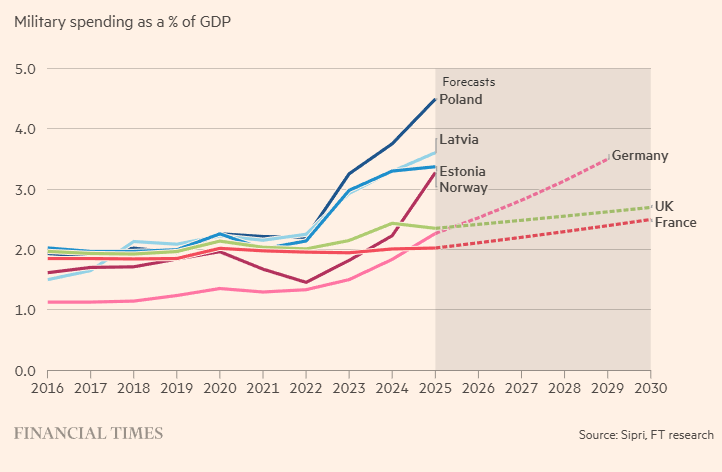
This year the US has also cancelled troop deployments, scaled back capabilities assigned to Nato and launched a six-month review of US military posture in Europe — a test that defence secretary Pete Hegseth says “some countries will fail, and others will pass”.
Rachel Ellehuus, a former US Pentagon official who is now director-general of the Royal United Services Institute in London, describes Hegseth’s review as the “shoe that hasn’t dropped”.
The Nato defence plans that leaders endorsed only a year ago assumed the US would still shoulder nearly 40 per cent of the warfighting burden; now that share is almost certain to shrink.
A further shock has been the rapid rundown in weapons stockpiles by the US and its Gulf allies during the war with Iran. Despite Rutte’s comments about vast US orders, European customers have been told they will have to wait several years for deliveries of US equipment, forcing them to look for domestic alternatives.
European officials now say they need to focus on more than boosting capabilities.
“Greenland put Europeanisation of Nato at the centre of the agenda,” says the French official. “Iran has pushed Europeanisation to one side. But it is more and more the only way to save Nato.”
There is little support in European capitals for giving the EU a greater role in military operations. Instead, they want to try to salvage Nato by making it less American.
“We need to think about Europe’s role in Nato’s command and thicken it up,” the British official says.
Replacing US forces and critical support assets, such as intelligence, reconnaissance, air defence and refuelling, will remain an aspiration unless European governments can increase defence spending more quickly.
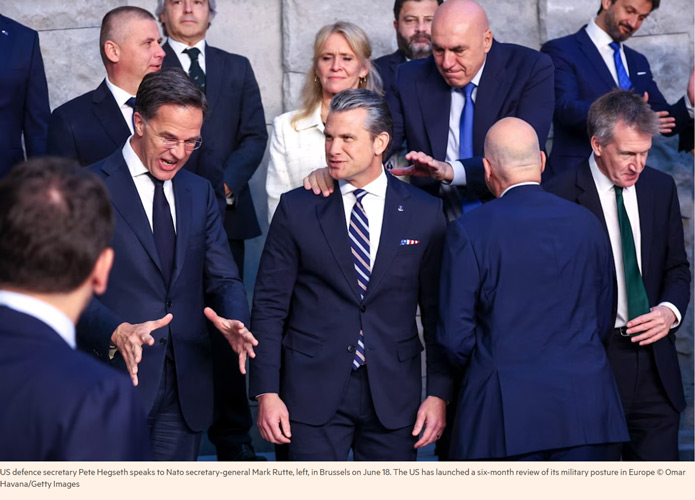
Germany and its Nordic and Baltic neighbours are spending heavily, with Berlin’s defence expenditure due to hit 3.5 per cent of GDP by 2029, well ahead of Nato’s target date of 2035.
But France and the UK, Europe’s two military heavyweights, are well off track. They are due to spend only 2.5 per cent and 2.7 per cent of GDP respectively by 2030. And even Germany lacks a long-term funding plan.
However, though spending more is necessary, it is no longer sufficient. “For me the main question is whether Nato should be just European-resourced or increasingly European-led,” says Jana Puglierin of the European Council on Foreign Relations think-tank in Berlin.
Focusing only on spending and capabilities is like adding European muscle to a body still dependent on an unreliable US brain, she says.
She favours building on the recent appointment of Europeans to Nato’s three operational headquarters — Brunssum in the Netherlands, Naples in Italy and Norfolk in the US.
Puglierin and her co-authors in a recent paper say each should be capable of leading large-scale operations — without the overall command of Nato’s supreme allied commander for Europe, a US officer.
So long, overwhelming force
In April, Challenger 2 tanks of the British Army’s Third Division thundered across the Estonian frontier, closing in on a Russian trench line outside a battered village.
Ahead, a Russian T-90 tank coughed black exhaust as it reversed out of range. Overhead, the air was thick with drones: fixed-wing reconnaissance aircraft, quadcopters and loitering munitions streaming live video to commanders hunched over tablets and laptops, directing strikes and tracking the battle almost second by second.
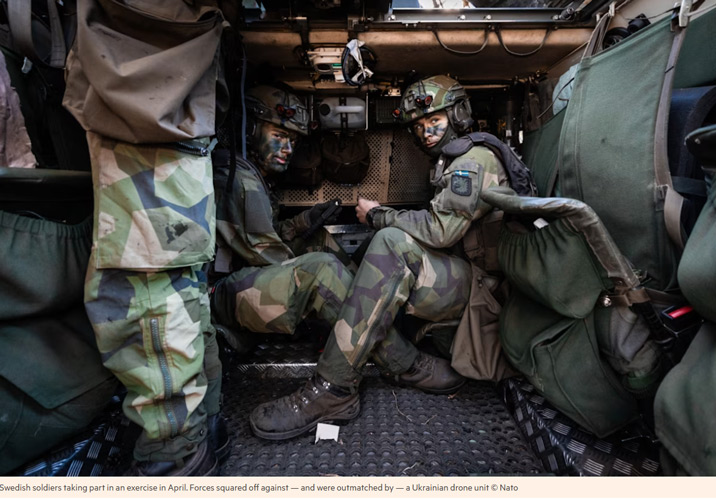
Swedish soldiers taking part in an exercise in April. Forces squared off against — and were outmatched by — a Ukrainian drone unit © Nato Fortunately, none of it was real. The T-90 was a Land Rover underneath a large tank-shaped tent; the eastern European-looking village was Copehill Down, a UK army training ground built during the cold war and now suddenly relevant again.
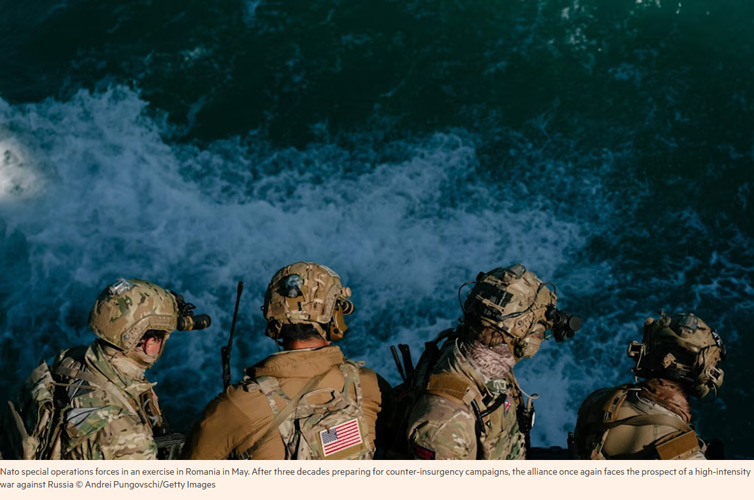
After three decades preparing for counter-insurgency campaigns, Nato once again faces the prospect of the high-intensity war against Russia that has always been its raison d’être.
But senior commanders and politicians admit that the alliance’s doctrine is outmoded. It has the wrong technology, and now US involvement is increasingly in question.
The exercise at Copehill Down — attended by military officials from roughly a dozen Nato countries — was part of an effort to learn the lessons from Ukraine, where cheap, expendable drones combined with sensors and networked data have slowed Russia’s advances to a crawl in ways that Nato commanders are just starting to register and plan for.
In a recent Swedish exercise, the country’s forces squared off against a Ukrainian drone unit, which won hands down.
“In Nato, you could say that our tactical/operational conceptual thinking rather stopped in about 1991. Really, nothing much changes after Gulf war I,” Johnny Stringer, deputy supreme allied commander for Europe, told a Rusi conference in London in June. “We’ve polished that for about 35 years, and we need to do something a little bit different.”
Without the US, it would be very different indeed. It might mean Nato learning to fight with what it has and looking to Kyiv as well as Washington for inspiration.
Ruben Stewart of the International Institute for Strategic Studies has recently sought to show how in a near-term war, European states would be able to wield conventional firepower on a par with Russia.
But without the US, he contends, their forces would be far less integrated, intelligence and surveillance coverage would be thinner, targeting cycles would be slower and decision making would be more cautious.
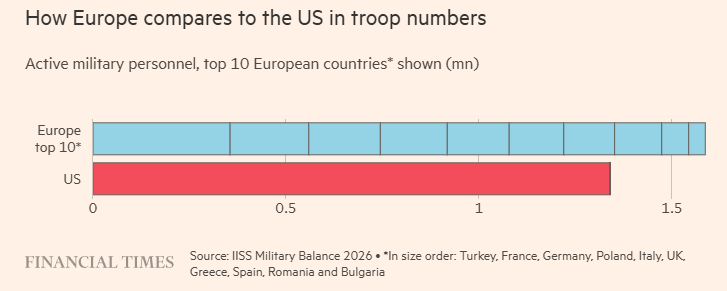
Without US capabilities to destroy Russian air defences, Europeans might struggle to establish air superiority, making ground manoeuvres riskier.
A second senior British official says: “The American way of war is to apply large amounts of force to the opponent’s centre of gravity and deny it the ability to fight. Europeans are not going to be able to apply overwhelming force. They will have to try to thwart, create dilemmas and put up a kind of porcupine defence.”
Nato is already adopting some of this thinking with encouragement from the US military, the official adds.
General Christopher Donahue, who stands down this week as the US commander of Nato land forces, has been spearheading the Eastern Flank Deterrence Initiative. The programme seeks to thwart a Russian invasion using fortifications and other defences, pervasive surveillance, AI-enabled targeting and cheap mass-produced drones and missiles, an approach pioneered by Ukraine.
Generals from Nato states say the alliance’s doctrine will need to be updated. The survivability of armour and vehicles under massive drone assaults is debatable at best. But many commanders say the answer is not to replicate Ukrainian tactics but rather to use new technology to protect manoeuvring combat troops.
“The logic of future weapons needs is not about choosing tanks or drones. It is tanks and drones,” says a senior European army officer. “It’s about hybridisation of capabilities.”
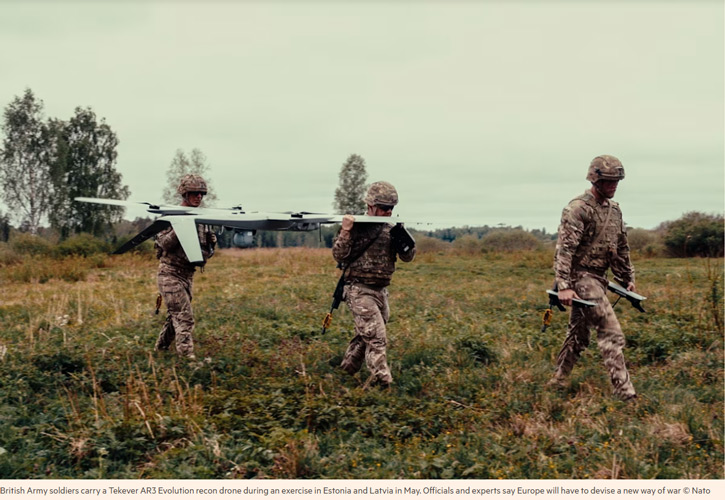
At the Copehill Down exercise, Major General Olly Brown, the commander of the UK’s third army division, argued that one principal challenge is to avoid armoured vehicles being neutralised by drones.
“The true lesson of the Ukraine conflict is not that predominantly static and attritional warfare is necessarily inevitable due to the proliferation of armed, uncrewed systems we have seen there — although that’s undoubtedly a problem that we must overcome,” he says. “It is that we cannot allow ourselves to be forced into a similar fight.”
‘Good enough’ weapons
Ukraine’s defence against a full-scale Russian invasion now in its fifth year has become a global blueprint for how future wars might unfold.
“The war in Ukraine is no longer just a regional war. It has become a global learning environment,” says a senior Nato military official. “Russia, China, Iran and North Korea are not simply watching this war. They are learning from it, supporting one another, exchanging technology and adapting.”
The military official adds: “Our responsibility is to learn from those lessons before we are forced to learn them ourselves.”
Indeed, Nato has set up an analysis centre in Bydgoszcz in central Poland to study the war and provide insights into future conflicts. The centre has a project on glide bombs — the low-cost projectiles Russia has used to devastating effect in Ukraine — that works with Kyiv to detect and destroy the weapons, with the aim of developing similar capabilities for Nato.
Kyiv’s resistance, now funded largely by the EU, is also buying Europe time to re-arm.
“Nato and Ukrainian security are parallel and intertwined,” says the senior UK official. “That’s not the way we thought about it a year ago. A strong Ukraine is in Europe’s interest in many ways, including in tying down large numbers of Russian forces.” With Ukraine’s dynamic arms manufacturers set to be an important part of the continent’s defence industry, Europeans are also beginning to see the attractions of Kyiv’s “good enough” approach to cheaper drones and missiles.
Turkey, one of Nato’s biggest military powers, also has a growing, innovative and low-cost defence sector which it says could play an indispensable role in Europe’s rearmament.
Ukraine’s rapid innovation and procurement cycles have sharpened frustration with cumbersome European processes and patchy ramp-up in manufacturing capacity.
Kyiv certified its new Flamingo cruise missile — a bulky, cheaper alternative to US technology that is improving in accuracy after an uncertain start — in only five weeks.
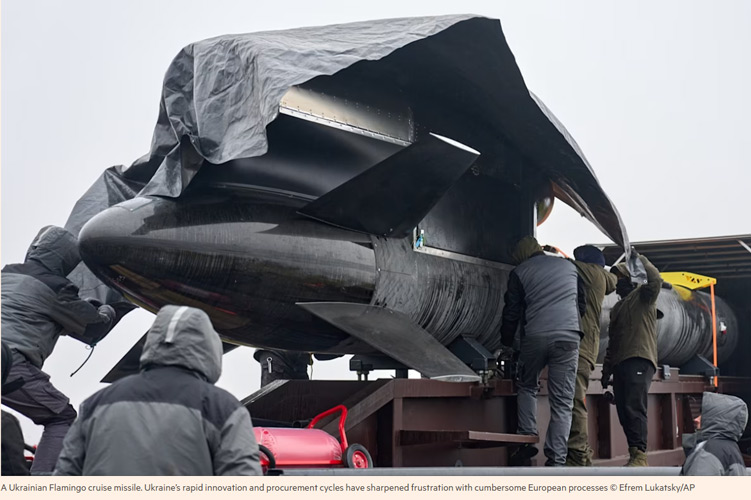
Germany’s Diehl Defence is now looking to manufacture Flamingo missiles domestically, one of a number of companies in the country seeking production agreements or joint ventures with Ukrainian defence firms.
Ukraine “understood that innovative [weapons] supply changes the whole modern warfare doctrine”, Andrius Kubilius, the EU’s defence commissioner, said last month. “Thanks to transformation of its war doctrine, Ukraine is prevailing,” he told a conference in Paris, as he urged Europe to take the same steps.
“The advantage that Ukraine has is that it knows very well which kind of war it is fighting. It can adapt and respond and develop in real time,” says a senior European military official.
“To be honest, we do not know what war we are fighting right now, let alone what war we may be forced to fight in the future, so it is very hard to decide exactly where and how to invest,” the official adds. “But we can try to shape any future war through what we procure.” A trust deficit inside Europe While there is a growing consensus in Paris, London and Berlin on the need to take more responsibility for conventional defence, not enough is being done to follow through at a working level, officials say. Many of the continent’s leaders are beset by domestic problems and lagging in the polls, and so lack the bandwidth to drive the Europeanisation forward.
Puglierin of the ECFR says a key problem remains a lack of mutual confidence among European states.
“The major problem is trust,” she says. “Many countries really trusted the US more than any of their European partners to come to their rescue. And now they kind of understand that this trust in the US is no longer merited. But that doesn’t lead to more trust in each other automatically.”
But François Heisbourg, a French defence analyst, says, given the collapse of confidence in US leadership, Europeans have no choice but to collaborate.
“We cannot expect Trump to help us in this field,” he says. “We’re going to have to set up our own shop, I assume within Nato, but a Nato where the Americans are going to play a diminishing role.”
Data visualisation by Keith Fray